
Leon County Address History Sources
Previous residents leave different records in each era. Deeds establish ownership, but they do not name every person who lived at the site. Directories, census schedules, and telephone books add occupants. Maps show whether a structure existed, while permits mark later work. Begin with the source closest to the date in question, then use the parcel's legal description to keep the same land in view.
| Source | Years It Covers | Where Held | What It Shows |
|---|---|---|---|
| Deed books and microfilm | 1825-1942 archive series; later Clerk records | Leon Clerk and State Archives | Parties, title chain, legal description |
| City directories | Clough 1904, 1914, 1916; Polk 1919 to at least 1970 | State Library, local repositories, NARA | Occupant, work, household note, address |
| Telephone directories | 1950-1960 | Library of Congress online | Listed person or firm, phone, address |
| Census schedules | 1825 local series; federal public schedules through 1950 | State Archives and NARA | Household at the census date |
| Sanborn maps | 1884, 1890, 1895, 1903, 1909 online; later cited sets | Library of Congress and NPS sources | Building footprint, use, old street label |
| Permits | Online start not verified | City Growth Management or county custodian | Work dates, applicant, contractor, inspections |
For recent Leon County previous residents, start with the current parcel and electronic deed index. For a date before that index, plan for Clerk books or State Archives microfilm. Occupancy still requires a second pass through directories and census records.
Start Leon County's Parcel Trail
The Property Appraiser connects a street address to parcel or tax ID, current owner, owner mailing address, site address, legal description, subdivision, exemptions, values, and sales. Save the parcel ID and full legal description before leaving the record. An owner mailing address can be another home, a firm, or a preferred mail point. It is not proof of who occupied the Leon County site.
TLCGIS adds city-limit, zoning, and map context. The parcel is the stable bridge when an old street name or number no longer matches. Leon County research did not find an authoritative countywide renumbering year, so no date should be invented. Match lot, block, subdivision, or section-township-range text instead.
Best bridge. Carry both the tax ID and legal description from the assessor into every deed, permit, map, and archive request.
Walk Leon County's Deed Chain
The Leon County Clerk Official Records service validates Official Records, Deed, and Mortgage books from January 1, 1945 through its current-through date. Its fields are document type, name in last-first-middle order, begin and end dates, book, and page. There is no street-address field. Start with today's owner from the parcel record and move seller by seller.
- Save the current parcel ID, legal description, owner, and acquisition book and page when shown.
- Find the deed naming that owner as grantee, the party receiving the interest. Record the grantor, date, instrument, and legal description.
- Search that grantor as an earlier grantee. Accept the link only when the lot or legal description matches.
- Repeat to the 1945 electronic boundary. Keep a log of every rejected same-name result.
- Continue with deed books and State Archives microfilm for older links, including the archive series that begins in 1825.
- Grantor and grantee
- The grantor gives or sells an interest; the grantee receives it.
- Chain of title
- The linked sequence of recorded transfers for the same land.
- Legal description
- The recorded land description, which remains useful when a street label changes.
- Book and page
- The volume and page reference used to retrieve a recorded instrument.
The captured Leon Clerk Official Records page is the online starting point for the backward chain.
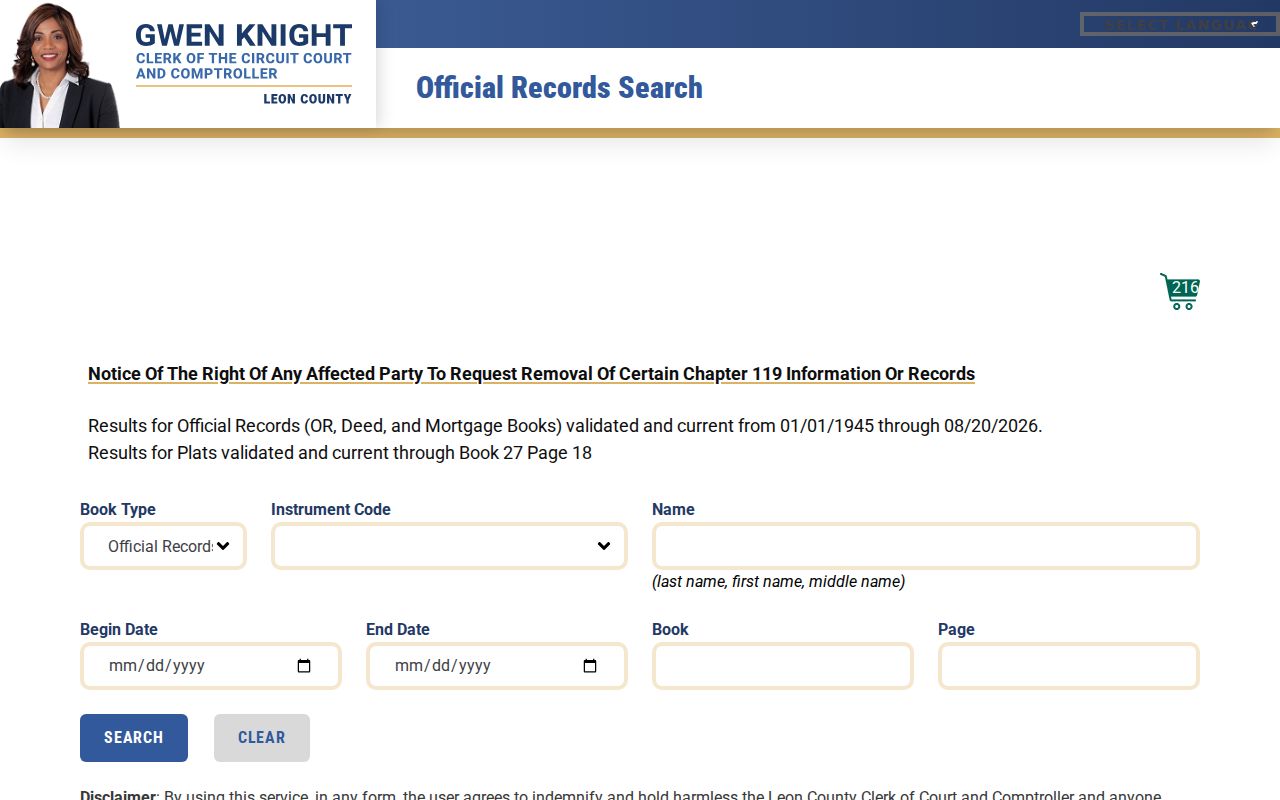
The screen leads to the named-record index, while older material requires the Clerk or archival route.
Leon County Records Before 1945
The web boundary is not the start of Leon County land records. Florida Memory identifies deeds from 1825-1942, marriages from 1825-1955, wills from 1839-1947, and court minutes from 1824-1887. Earlier deed images or metadata may need inspection through the Clerk or the State Archives of Florida. Ask for the existing book, index, or microfilm rather than a broad search.
The Clerk's Official Records Division can be reached at 850-606-4030. Service points listed in the research are 1276 Metropolitan Boulevard, Suite 101, and 301 S. Monroe Street, Suite 100. Copies cost $1 per page, and certification adds $2 per document. An ordinary scan may be enough for a working chain, while a certified copy is the official attested version.
Note: A surviving 1825 deed series does not mean that every deed image or index entry is available on the web.
Leon County's Survey Starting Point
Tallahassee's 1824 Prime Meridian Marker is the initial point for Florida's public-land surveys and the original southeast corner of the city. Modern parcel descriptions that use section, township, and range sit within that survey geography. This local marker helps explain why the legal description can outlast a house number.
Leon County also bought an iron fireproof safe in 1861 for $711.55. Records were moved to Albany, Georgia, in 1865 and returned in early 1866. The courthouse burned in 1879, yet surviving territorial series show that the event did not destroy every early record. A 1941 inventory found seven vaults and territorial volumes split between the courthouse and State Library. Check both.
Date a Leon County Building
Sanborn maps can show whether a building footprint stood on a Tallahassee lot, its use, and the street label then in force. Online sheets exist for August 1884, May 1890, September 1895, May 1903, and February 1909. NPS documentation cites coverage through 1930 with 1959 revisions. The map dates the structure and its context, not the family inside it.
For later change, the Tallahassee Growth Management request covers building construction and land-use records. Staff expect to respond within three business days and deliver digital records by email or file-sharing site. Include the property address, parcel ID, record type, and date range. The page is not a citywide search or an official lien search, and staff will quote fees or exemptions when applicable.
Place Leon County Past Households
Owners are only half the address history. Tallahassee directories can identify an occupant, spouse notation, work, employer, address, or phone. Verified runs include Clough editions in 1904, 1914, and 1916, Polk from 1919 to at least 1970, and telephone books from 1950-1960. The exact shelf and reading methods belong to the Leon County city directories collection.
Pair 1925-30 directory years with the 1930 census. Pair 1950s telephone pages with the released 1950 census. The process is simple: directory address to census district, census household to adjacent directory year, then obituary or deed for the next dated event. A first absence never proves death. The person may have moved, chosen an unlisted phone, or been omitted.
- Transcribe the full directory entry and publication year.
- Locate the address in the matching or closest public census.
- Compare names, ages, roles, and nearby addresses without forcing a match.
- Check the next directory issue for a move or first absence.
- Use an obituary, cemetery record, probate file, or later deed to close the trail.
Close Leon County Resident Trails
The Clerk's Historic Probate Lookup asks for exactly the first letter of a last name and returns a case number for microfilm lookup. The official page gives no year range. That small bridge can lead an heir researcher from a surname to an offline estate file, which may explain a deed transfer after death.
John G. Riley Digital Archives adds funeral programs and obituaries from the 1800s through 2017, mainly for Tallahassee residents. Tallahassee's cemetery database holds nearly 21,000 records, though it mainly reflects burials recorded since the mid-1980s and excludes private cemeteries. Death certificates can corroborate the endpoint, subject to Florida's access limits.
The Florida death certificate service explains record types and ordering channels.
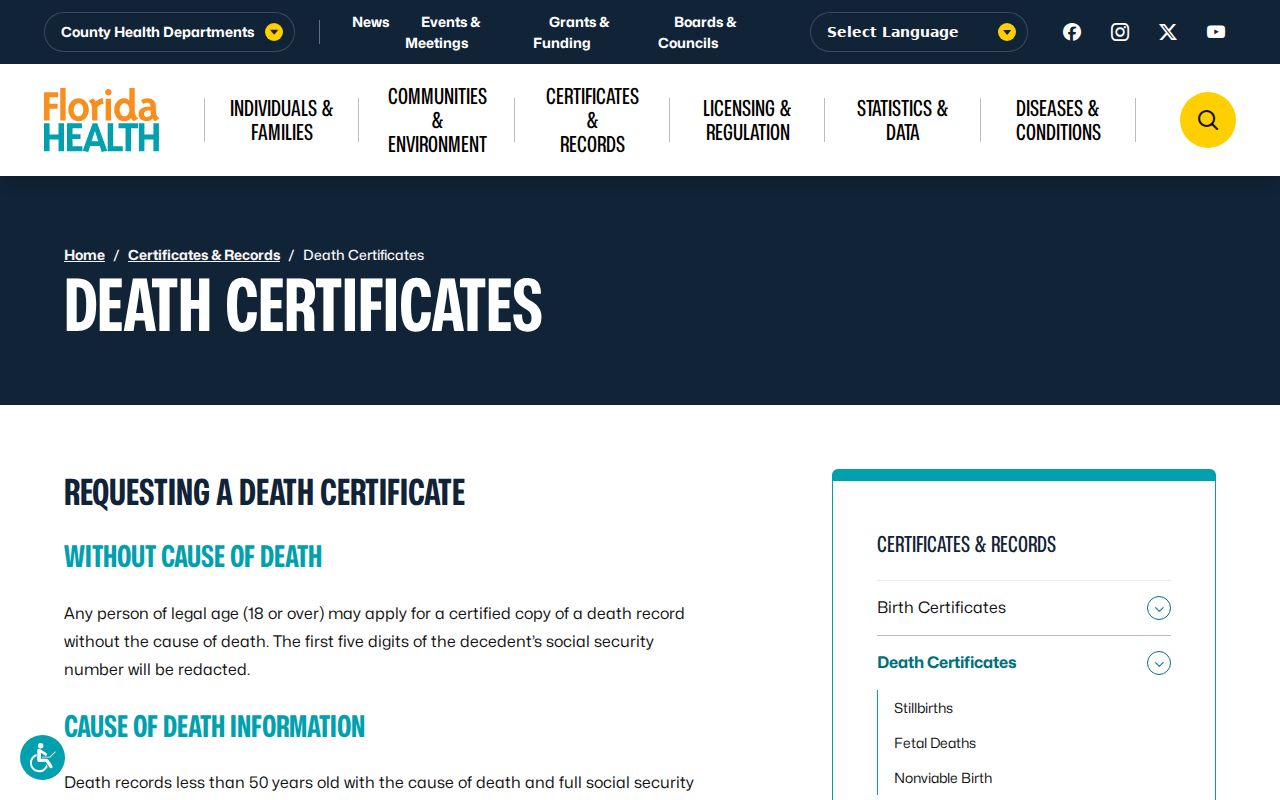
A certificate should confirm a known person and date, not substitute for linking that person to the address.
Limits on Leon County Previous Residents
No single source provides a full household roster. A deed identifies parties to a transfer. The assessor identifies an owner, not all occupants. Directories may omit people, while released census schedules capture one census date. Protected or sealed records remain unavailable. Each conclusion should state what the record proves and what remains an inference.
Leon County previous-resident research is well suited to family history, estate work, and curiosity about a building. Respect living people. Do not publish sensitive details or use old and current addresses to follow, threaten, or harass anyone.
Lawful use. Use address history for a legitimate personal purpose, and stop where privacy protections or a custodian's access rules apply.